iPhone Duo Teardown: Best Foldable Repairability, Hinge Concerns
iFixit's teardown gives Apple's first foldable the highest repairability score of any foldable it has tested. The team also found clues to what may be behind early screen failures.
 Merhabyte Newsdesk · · 3 min read
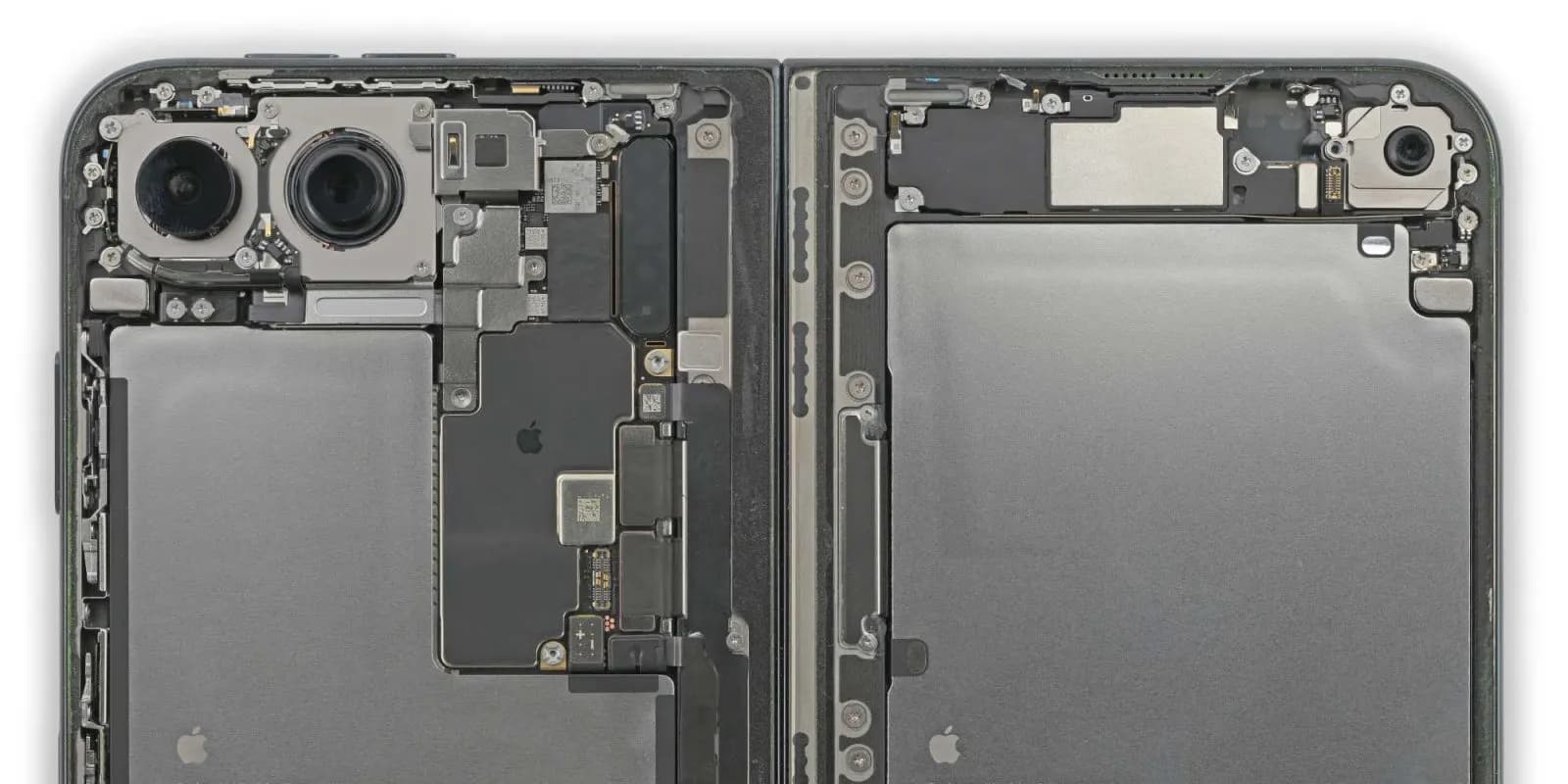
iFixit has published its teardown of the iPhone Duo, and the headline result is the repairability score. The device earned 5 out of 10, the highest rating iFixit has given a foldable smartphone to date. The score is provisional and depends on replacement parts going on sale.
The teardown is not all good news. In the hinge's internal structure, iFixit found clues to what may be behind the early screen failures that owners have reported. These include a crackling sound when folding and unfolding the phone, followed by bright lines appearing on the inner display.
Hinge design and the dust test
iFixit used a fluorescent dust test during the teardown to trace particles that get into the phone. The iPhone Duo carries an IP68 rating, meaning full dust protection and water resistance at a depth of 6 meters for 30 minutes. After the test, the team noticed the hinge starting to make crunchy sounds. Even so, the amount of dust that made it into the hinge was small compared with the other foldables the team has tested.
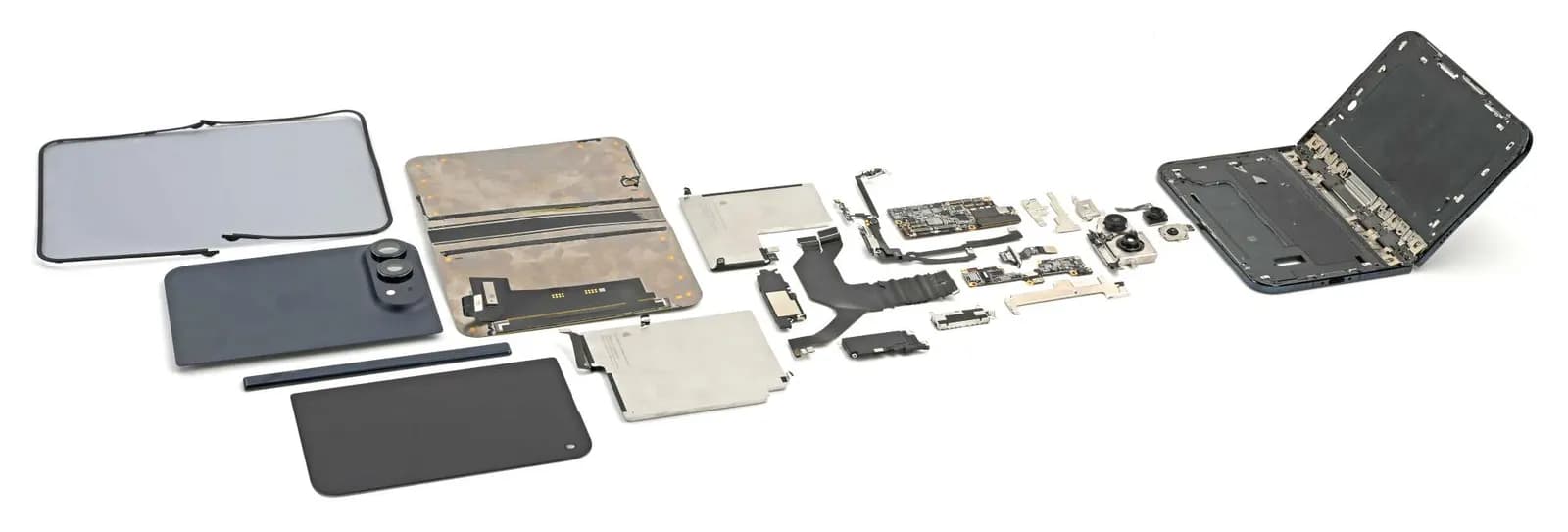
The hinge is a complex assembly of gears, springs and interlinked metal joints. Its teardrop-shaped design, which gives the screen room so it does not bend at too sharp an angle, is now a common solution among foldables. Apple adds its own engineering touches, though. Curved guides that steer the movement of the joints are meant to reduce the strain on the display as the phone opens and closes.
Possible sources of the screen failures
Many of the reported failures occur in the same area of the screen: the transition between the opening where the cable connecting the two halves passes through and the central hinge support. Using CT scans, teardown imagery and Apple's patents, iFixit built a three-dimensional model of the hinge.
The first possible cause is that the central support bar does not retract properly as the phone closes, putting too much pressure on the display. The second is the curved guide rails, which rise above surrounding components during folding. If they do not move as intended, they could in theory collide with the screen. Several structural edges and components also converge in that region and could concentrate stress on the delicate display layers. iFixit says it could not pin down the cause with certainty, but the similarity between the reported damage and the hinge's internal geometry gives the team promising leads for further investigation.
Matte nano-texture and pixel layout
Apple says the matte nano-texture display helps disguise the crease by scattering reflected light. Under a microscope, iFixit saw a surface covered in tiny rounded bumps that diffuse reflections and make the crease less noticeable. The team also noticed that some subpixels are oval-shaped and face different directions rather than following a regular pattern. According to iFixit, an Apple patent suggests this arrangement could reduce diffraction-related image distortion and make the crease even less visible.
Above the inner selfie camera, Apple appears to have taken an approach similar to the under-display infrared camera on the iPhone 18 Pro. The pixel pattern is altered and the gaps widened so light can reach the camera beneath. In this area the pixels become rounder and more regular.
Batteries and ease of repair
Apple has placed the two battery cells in different halves of the device, one under the back glass and the other under the outer display, so replacing both means opening both halves of the phone. The larger battery has a capacity of 11.567 Wh and the smaller one 7.506 Wh, for a total of 19.073 Wh. Both use electrically releasable adhesive, so the cells can be removed without prying. iFixit called it the best battery removal experience it has seen in a foldable.
The frame around the inner display comes off without breaking because it relies on clips rather than adhesive alone. The outer display is also surprisingly easy to remove, a significant advantage given that several internal repairs require taking it off first. The teardown also covers the new logic board design and the display layers that move independently of one another to accommodate folding.