Google signs Blue Origin deal to put data centers in orbit
Under Project Suncatcher, Google will launch small satellites carrying its AI chips on Blue Origin's New Glenn rockets. The first launch is planned for early 2029.
 Merhabyte Newsdesk · · 2 min read
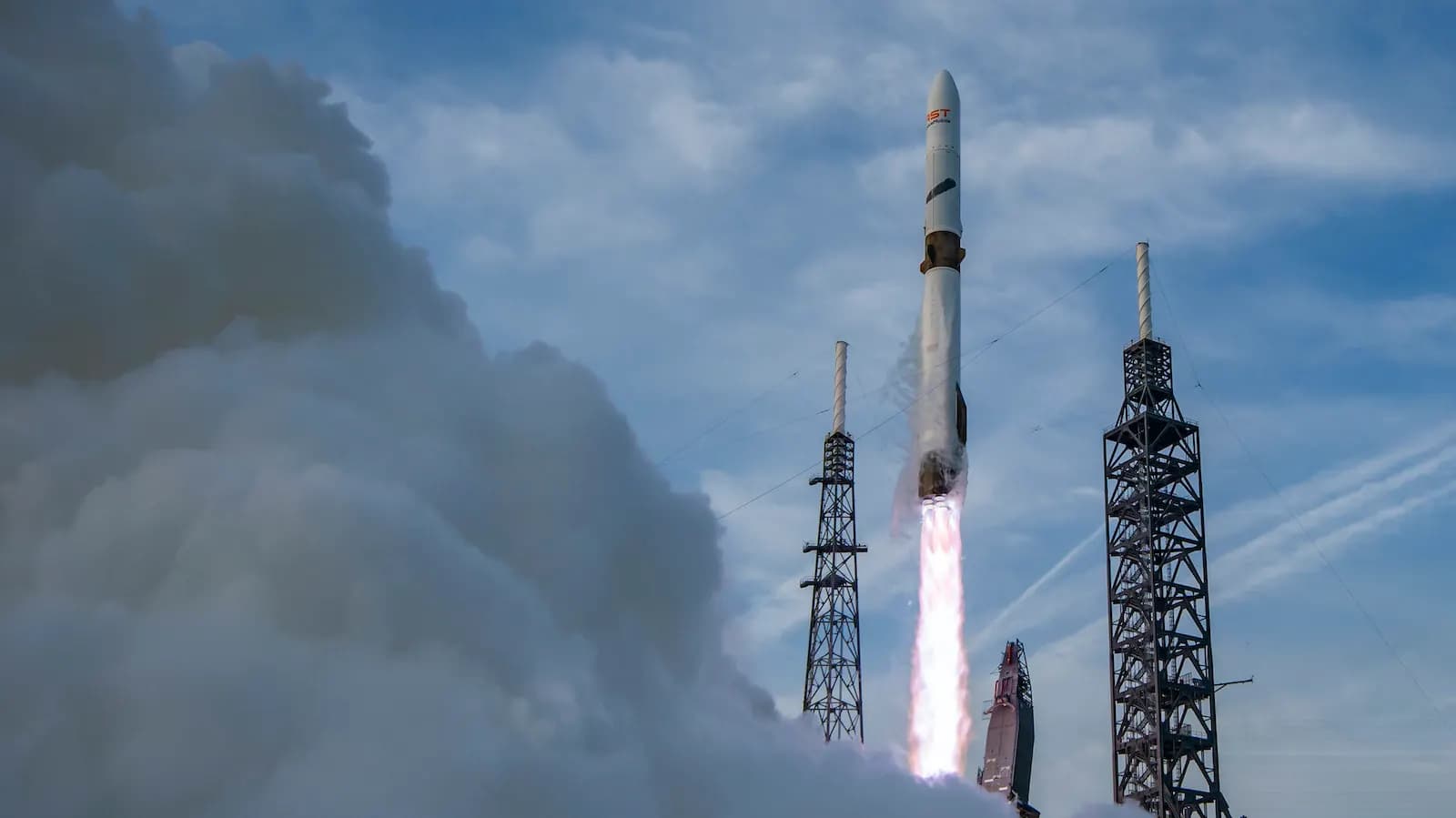
Google has signed a launch services agreement with Jeff Bezos's space company Blue Origin for Project Suncatcher, its effort to run AI systems in space. Under the plan, small satellites, each roughly the capacity of a single data center rack, will be placed into a sun-synchronous orbit by New Glenn rockets, which can carry heavy payloads.
The rockets will carry Google's own AI chips, Tensor Processing Units (TPUs), along with data center servers. The first launch is planned for early 2029, which leaves a few years before anyone can judge whether the project actually works.
What Project Suncatcher is trying to prove
Google describes Suncatcher as a long-term moonshot. The goal is to test whether AI infrastructure can be moved off the planet to take advantage of the abundant solar energy available in orbit. Blue Origin's announcement frames the project as a research effort asking whether a network of interconnected, solar-powered satellites fitted with TPUs can scale machine learning.
Data centers on Earth put heavy strain on power grids, land and cooling systems. The hope is that the harsh vacuum of space will prove a better environment for the technology. It is also thought that the constant noise that people living near data centers complain about could be eliminated.
Rivals and the first test
Google is not alone in this field. Elon Musk's SpaceX is also experimenting with the idea, and its work is said to include placing a giant catapult on the Moon. Startups such as Starcloud are working on related technologies as well.
Google launched its first AI server satellite last October. That satellite went into low Earth orbit and can operate for only 15 minutes at a time. The planned venture with Blue Origin is a much larger undertaking, with multiple satellites and far more hardware, placed in a sun-synchronous orbit.
The obstacles ahead
Cooling is one of the biggest technical challenges. Because the usual ways of shedding heat do not work in space, heat has to be carried away through pipes and panels, and scaling those cooling systems up looks extremely difficult. Radiation is another problem: it is everywhere in orbit and can cause so-called bit flips, turning a one into a zero or a zero into a one in binary code, a serious issue for systems that run on binary.
Cost is a separate barrier. Sending anything to space is very expensive: a single Falcon 9 launch costs about $74 million, and the maximum payload barely covers the hardware of a small server room, let alone a hyperscale data center. Brandon Lucia, a professor of electrical and computer engineering at Carnegie Mellon University, says that going from a single satellite to a network acting like a giant data center would take years and substantial resources, and that additional engineering problems would emerge at scale.
Finally, there is a risk for people on the ground. In the Kessler syndrome scenario, debated for decades, the density of objects in low orbit becomes so high that collisions turn routine and set off a chain reaction of debris. When the theory was proposed, about 2,000 objects were circling in low Earth orbit; that number has now passed 47,000. Musk has reportedly floated the idea of adding millions of new satellites to orbit in the near future.
Add as a preferred source on Google
Comments
No comments yet. Be the first to comment.