
Google Releases Gemini 4 Neon to AI Pro and Ultra Subscribers
Google says Gemini 4 Neon matches or beats Carbon on key tasks at Flash speeds and lower cost, and it is now rolling out to paid Gemini subscribers.
 Merhabyte Newsdesk · · 2 min read
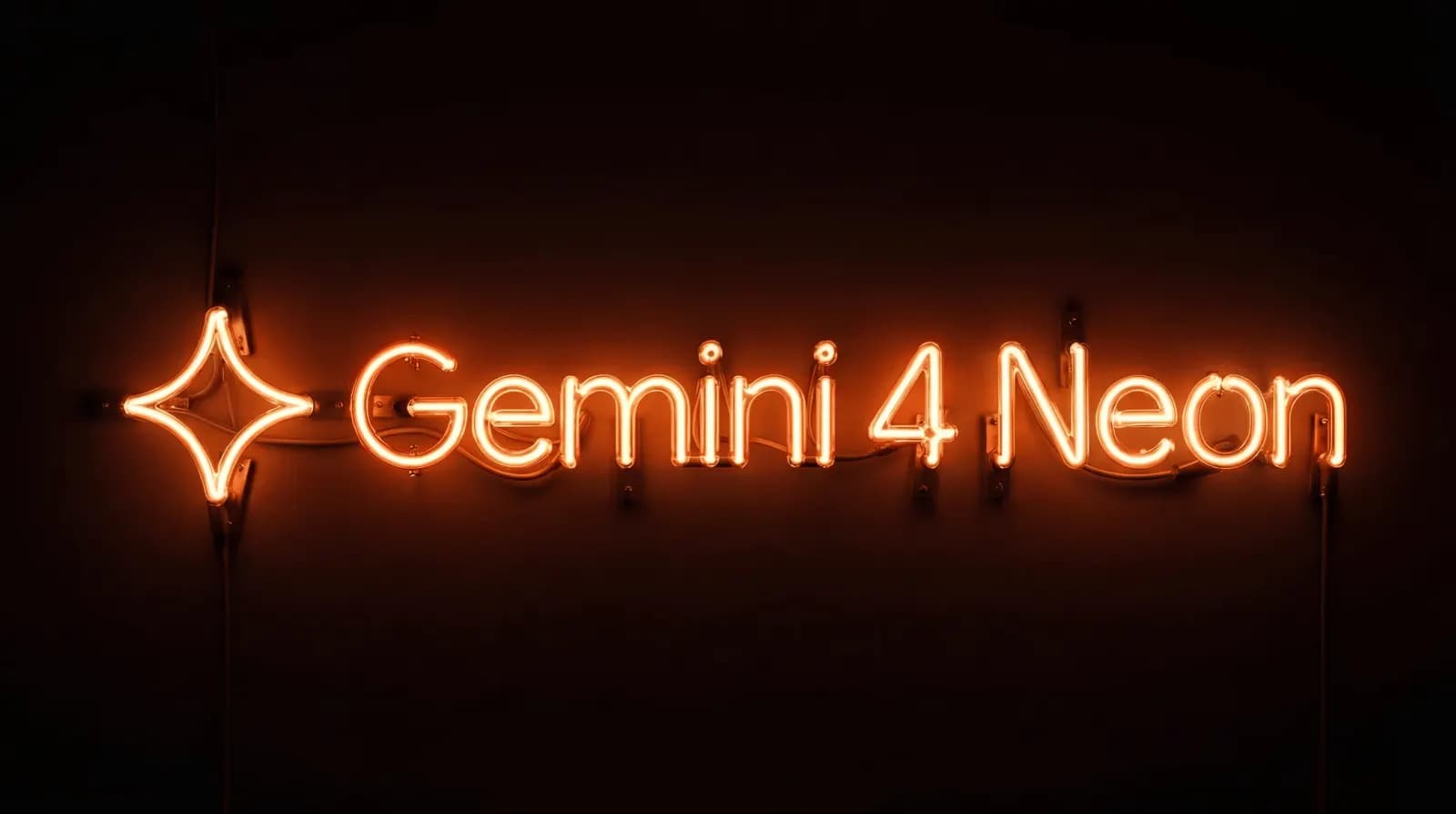
Google has released Gemini 4 Neon, the newest member of the Gemini 4 family, following the Carbon and Hydrogen models it announced last week. The company describes Neon as a faster, more cost-effective option for complex, high-volume workflows, offering what it calls frontier-level reasoning.
According to Google, Neon delivers performance comparable to, and in some cases better than, Carbon in coding, reasoning and agentic tasks, while running at Flash speeds and at a lower cost. The model is now available in the Gemini app to AI Pro and AI Ultra subscribers.
Changes to the Gemini app
Neon's arrival brings several changes to the model picker in the Gemini app. Neon replaces Argon, which was previously available, while Gemini 3.1 Pro is being removed from the app. For paid users, 3.5 Flash-Lite now appears in the picker as the "Auto" option.
The model is also available in Google Antigravity for paid AI Pro and Ultra subscribers.
Where it sits in the Gemini 4 family
Officially, Neon slots between Hydrogen and Carbon in the Gemini 4 lineup. Google positions Carbon for the most demanding, long-running projects and Hydrogen for quick everyday tasks, with Neon aiming to balance depth and efficiency between the two. Complex coding, analytical reasoning and production-grade enterprise workflows are listed as its main use cases.
On the technical side, Neon offers a 1 million token context window, like Hydrogen, and includes four thinking levels: Low, Medium, High and Extra High.
Pricing and the naming debate
Neon is priced at $3 per million input tokens and $15 per million output tokens, twice the price of Hydrogen. Argon and Carbon are offered at a promotional rate of $2 per million input tokens and $10 per million output tokens through November 30. When that period ends, their prices rise to $4 and $20 respectively, at which point Neon will be 25 percent cheaper.
The launch has also revived criticism of Google's model naming. Commenters on the original report argue that earlier labels such as Flash and Pro made it easy to tell which model was more capable and which was lighter and faster, whereas names like Argon, Hydrogen, Carbon and Neon give users no hint about which one suits their needs. The same comments note that other major AI companies have followed a similar naming trend.
Add as a preferred source on Google
Comments
No comments yet. Be the first to comment.


