
Google Launches Gemini 4 Hydrogen, Now Live in the Gemini App
Google has introduced Gemini 4 Hydrogen under a new name rather than the Flash branding. The model is available in the Gemini app, the API and developer tools.
 Merhabyte Newsdesk · · 2 min read
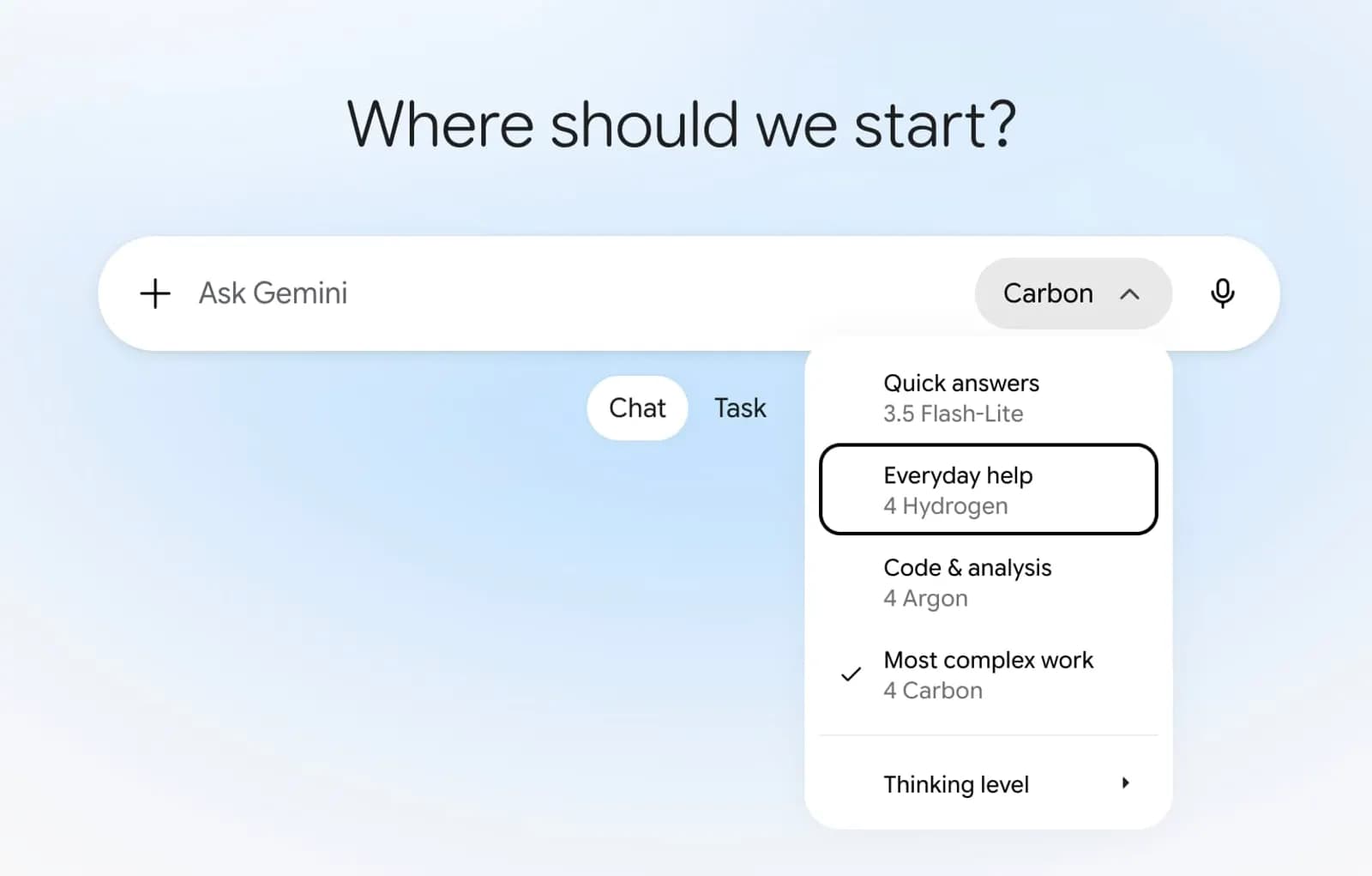
Google has added Gemini 4 Hydrogen to the Gemini model family. Rather than carry on the Flash branding, the company gave this model a new name. The announcement comes after the Carbon model, which became available earlier this week.
According to Google, Hydrogen brings frontier-level intelligence together with speed and efficiency for everyday coding and agent-based workflows, and puts it within reach of everyone. The model is rolling out across a wide range of surfaces, from the Gemini app to developer tools.
Performance and technical specifications
Google says Hydrogen outperforms Argon on the Artificial Analysis Intelligence Index at the default high thinking level. By the scores the company shared, Hydrogen scores 51 at that level while Argon stays at 50. At the highest xhigh thinking setting, Hydrogen's score rises to 54. Google also says the model often completes tasks faster than comparable models in its class.
The model natively supports up to 1 million input tokens and up to 1 million output tokens. Google describes Hydrogen as a "major standalone upgrade" over Gemini 3.8 Flash, which shipped on September 2, and claims significant jumps in both speed and intelligence. After 3.8 Flash, the company had turned its attention to frontier models with Argon and Carbon.
Use in the Gemini app and Antigravity
In the Gemini app's model picker, Hydrogen appears under the label "Everyday help." Free users can reach the model through automatic model selection, which kicks in when it suits the type of prompt.
In Google Antigravity, Hydrogen comes with a thinking tier called "Extra." Google also introduced a new feature called Orchestrator. Instead of running a single model from start to finish, Orchestrator switches dynamically between models such as Carbon and Hydrogen within the same session. As Google describes it, Carbon can hand routine steps off to Hydrogen, and the company says this approach preserves Carbon-level quality while spending fewer tokens.
Parallel agent workflows and pricing
In workflows that call for parallel agents, Carbon can act as the coordinator while Hydrogen runs the worker and verifier agents. That lets changes be built and tested at the same time in isolated workspaces. Google says this approach should help teams finish complex projects faster without driving up token costs.
For developers, Hydrogen is priced at $1.50 per million input tokens and $7.50 per million output tokens. According to Google, the model is available across all tiers of Google AI Studio, in the Gemini API, in Gemini for business, in the Gemini app and in Google Search. In Google Antigravity, paid Google AI Pro and Ultra subscribers can access it.
Add as a preferred source on Google
Comments
No comments yet. Be the first to comment.


