Altman Meets Samsung and SK Group Amid Memory Shortage
OpenAI's CEO met Samsung's top brass and SK Group's chairman in Seoul. The official occasion was an AI seminar, but the memory shortage was never far from the agenda.
 Merhabyte Newsdesk · · 4 min read
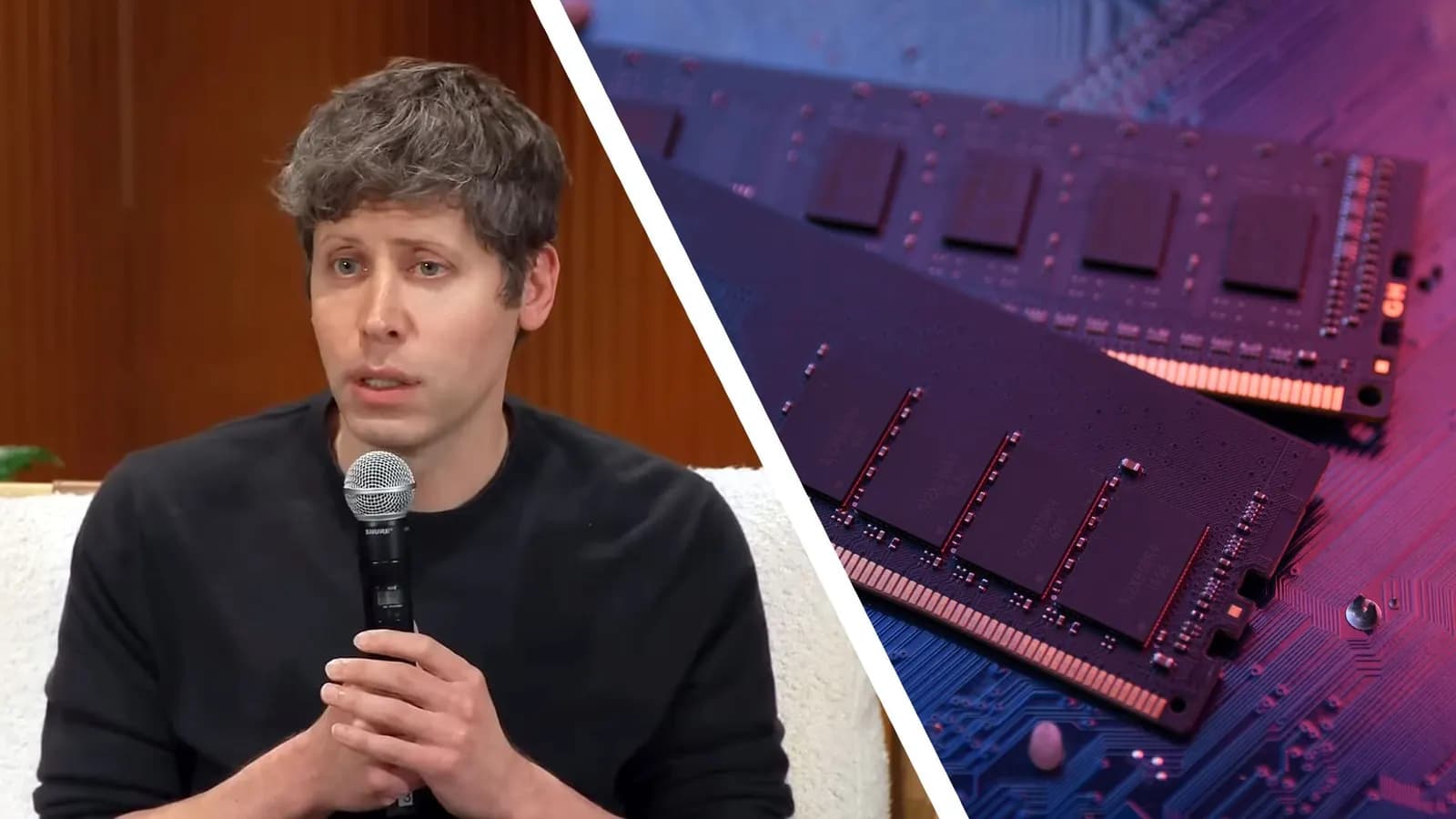
OpenAI CEO Sam Altman recently met senior figures from South Korea's two biggest memory makers. The session, held at Samsung's Human Resources Development Center in Yongin, south of Seoul, was billed officially as a seminar on how AI will change management. Investors and financial circles, however, read the visit as an effort to deepen cooperation on memory chips and AI infrastructure at a time of acute global shortages.
Both readings can be true at once. The timing is striking: Altman was in Seoul only days after saying that the world's memory supply is badly allocated. Nearly every major AI player, OpenAI included, is running into hard limits on the memory, compute and financing it can get.
A senior-level table under a seminar banner
According to accounts of the event, the meeting was held under the theme "The Next 10 Years Shaped by AI: The Institution's Choice" and was the second intensive AI training program Samsung has run for its top management in 2026. Executives from its electronics, finance and biotech affiliates took hands-on generative AI training before Altman joined.
The attendee list was not limited to general management. Jun Young-hyun, vice chairman of Samsung's Device Solutions division, which runs its chip business, was in the room, as was Song Yong-ho, who heads that division's AI Center. Altman brought four executives of his own, among them Richard Ho, OpenAI's vice president for hardware. In other words, the head of the chip business was at a table of roughly 50 senior executives.
Samsung's statement said only that the two sides discussed the direction of AI technology and possible areas of application; no new memory supply deal was announced. Altman's message to the room was also less about buying chips than about using AI: he said that adopting AI alone is unlikely to deliver a lasting competitive advantage. He also gave attendees the Codex Micro, a 13-key, $230 device built with Work Louder to control OpenAI's Codex coding agent. Song was among the recipients, an unusual gift for a company that makes some of the most advanced memory chips in the world.
A second stop in Seoul: SK Group
Samsung was not Altman's only stop in Korea. Before leaving the country, he had lunch in Seoul with SK Group Chairman Chey Tae-won and senior executives from SK hynix and SK Telecom. Details of that meeting were not shared.
In short, OpenAI's CEO met Korea's two big memory producers within hours of each other, with his hardware chief in tow, and left without announcing anything. One analysis notes that none of the parties has confirmed that chip prices or investment commitments were discussed. A push for more memory is a reasonable inference, but it is not an established outcome.
Memory has become AI's bottleneck
What makes that inference plausible is that the binding constraint in AI is now capacity rather than demand. In a podcast interview, Altman called it "pretty bad" that so much of the world's DRAM sits in personal computers, described the environment as one of "very high supply constraint," and predicted that each memory maker would generate roughly $100 billion a year in free cash flow.
Supplier data backs this up. Samsung has said its 2027 HBM supply is already sold out, while SK hynix says its DRAM and HBM output is effectively reserved through 2029. Kim Ki-tae, SK hynix's head of HBM sales and marketing, told analysts that customers are asking for more than twice the volume it can deliver. By industry figures, Samsung holds 39.4 percent of second-quarter DRAM revenue and SK hynix 24.9 percent, so the two together control about 64 percent.
The squeeze shows up further down the chain too. Microsoft said demand for AI infrastructure exceeds available capacity and that spending will rise as delayed third-party capacity comes online. Roughly three quarters of its $45.2 billion quarterly capital expenditure went to short-lived assets such as GPUs and CPUs, and rising memory and storage costs noticeably inflated the bill.
AI providers are rationing what they have. Reportedly, OpenAI stopped new sign-ups for its most expensive ChatGPT Pro tier in September after demand for its Astra model outstripped capacity. Elon Musk, for his part, said xAI cut usage limits on its Grok Bot because the cost of serving it was unsustainably high relative to revenue. On the surface that is a cost problem rather than a capacity problem, but the two are linked: the memory inside every accelerator is sold at whatever price the seller sets.
As previously reported, Samsung is shifting 60 to 70 percent of its capacity into five-year supply agreements, which for mainstream products include floor prices and substantial upfront payments as contract conditions. That makes locking in more memory as much a matter of financing as of diplomacy.
Comments
No comments yet. Be the first to comment.