M6 MacBook Pro 14-inch review: faster chip, familiar body
The 14-inch MacBook Pro keeps its design but gains the M6 chip, Wi-Fi 7 and Bluetooth 6. Memory and storage price increases push the starting price to $1,999.
 Merhabyte Newsdesk · · 3 min read

Apple has refreshed its entry-level 14-inch MacBook Pro for another year without touching the chassis. According to the review, the laptop looks identical to last year's M5 model from the outside, but it carries meaningful hardware upgrades inside, in both performance and connectivity. At its heart is the new M6 chip, which was introduced earlier alongside the refreshed Mac Mini.
On the connectivity side, Apple's own N1 chip brings Wi-Fi 7 and Bluetooth 6 support. Industry-wide increases in memory and storage prices have also pushed the model's starting price up to $1,999.
Same design, same ports
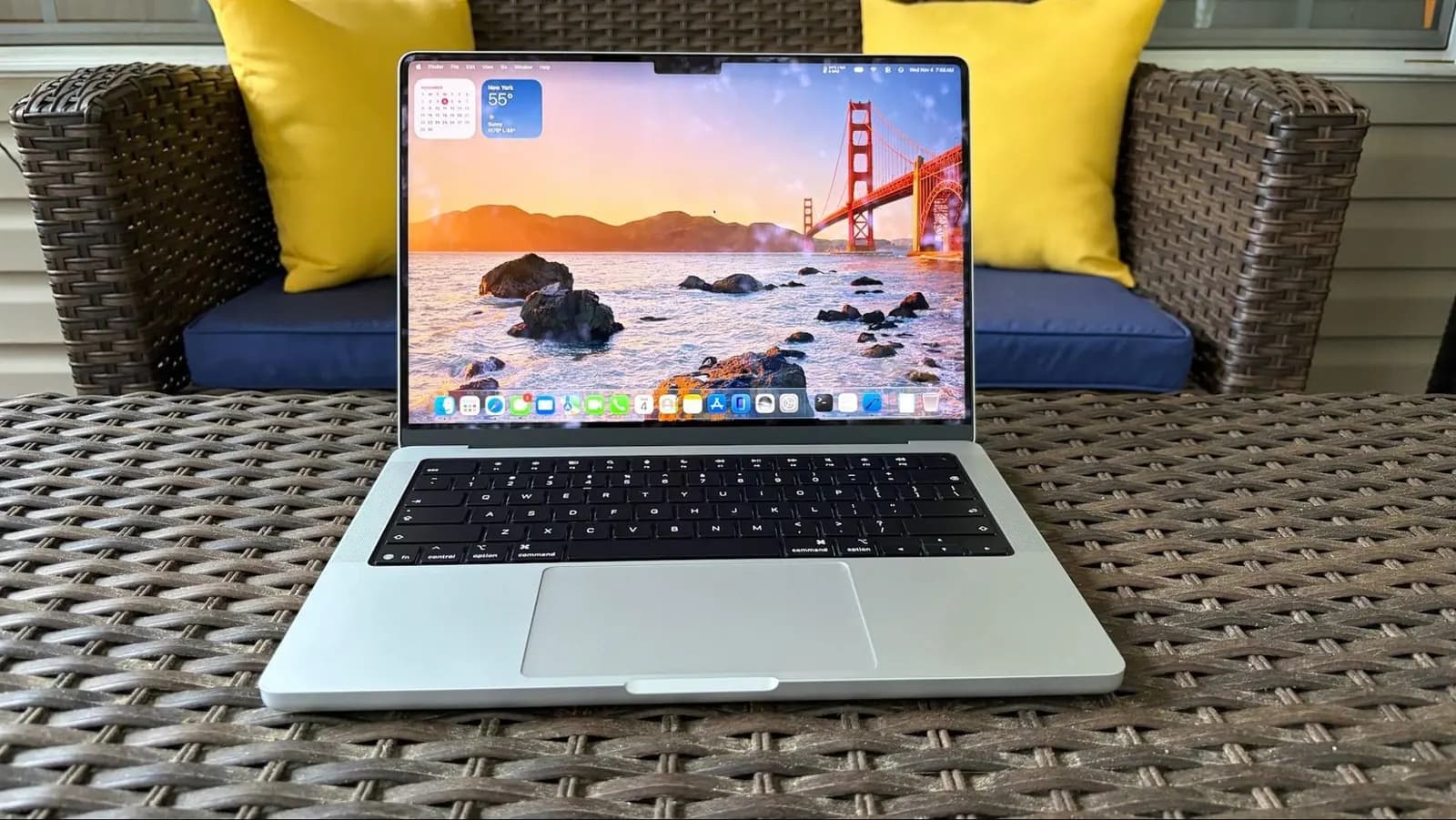
Apple has used the same design for the entry-level MacBook Pro since 2021, and this year is no exception. The review says the machine still looks good but is starting to show its age. The review unit arrived in silver rather than space black; the reviewer notes that space black attracts fingerprints, while the lighter color hides skin oils better. The notch above the display looks dated next to the Dynamic Island on the pricier MacBook Pro models, though the fact that it sits within the menu bar area limits the visual annoyance.
One complaint from the reviewer's earlier MacBook Pro reviews remains unresolved: the sharp corners of the keyboard recess that makes it easier to open the lid can irritate the palms while typing. The ports are unchanged from the previous generation: three Thunderbolt 4 ports, a full-size SDXC card reader, HDMI 2.1, a 3.5 mm headphone jack and MagSafe 3. Thunderbolt 5 is absent from the M6 models. The laptop weighs 1.55 kg and is 15.1 mm thick, matching last year's M5 model.
How the M6 chip performs
The review unit pairs an M6 chip with a 12-core CPU and 12-core GPU with 16 GB of unified memory and a 1 TB SSD. According to the review, the M6 model beat the previous-generation M5 MacBook Pro in the productivity tests that were run, and it also outpaced the Windows 11 laptops in the comparison, including the Gigabyte Aero X16 (AMD Ryzen AI 7 350) and the Dell XPS 14 (Intel Core Ultra X7 358H).
In Geekbench 6, single-core performance rose roughly 10 percent over the M5, from 4,288 to 4,752. In the multi-core test the gap exceeded 18 percent. The closest Windows rival was the XPS 14, which scored 2,867 and 16,927 in the single- and multi-core tests respectively. In a Handbrake test converting 4K video to 1080p, the M6 finished in 2 minutes 50 seconds, while the M5 took 3 minutes 31 seconds.
SSD performance, by contrast, barely changed year over year: in a 25 GB file transfer test, the M5 delivered 1,917.35 MBps and the M6 1,914.23 MBps. The best on the Windows side was the Aero X16 at 1,480.57 MBps. To gauge endurance under sustained load, Cinebench 2026 was run 10 times in a row; the M6 model started at 5,026.55 points and hovered around 5,440 in the remaining runs.
Gaming and display
The base MacBook Pro is no gaming powerhouse, but in Cyberpunk 2077 with the "For this Mac" preset it managed 53.7 frames per second at 1800 x 1125 and 32.66 fps at 3024 x 1890. The M5 model had posted 47.65 and 31.47 fps respectively.
The display is unchanged: a mini-LED-backlit IPS panel with a 3,024 x 1,964 resolution and a 120 Hz refresh rate. It looks good, but it is not on the level of the pricier models with the touch-enabled PROLED XDR screen. Buyers can add $150 for a nano-texture display option, though the review unit did not have it. The configuration tested costs $1,999.
Comments
No comments yet. Be the first to comment.