Google's Gemini 4 Carbon Tops the Intelligence Index
Google's new Gemini 4 Carbon edges out Claude Opus 5.5 by a single point on Intelligence Index V5 and posts the highest score on the AA-Omniscience hallucination test.
 Merhabyte Newsdesk · · 3 min read
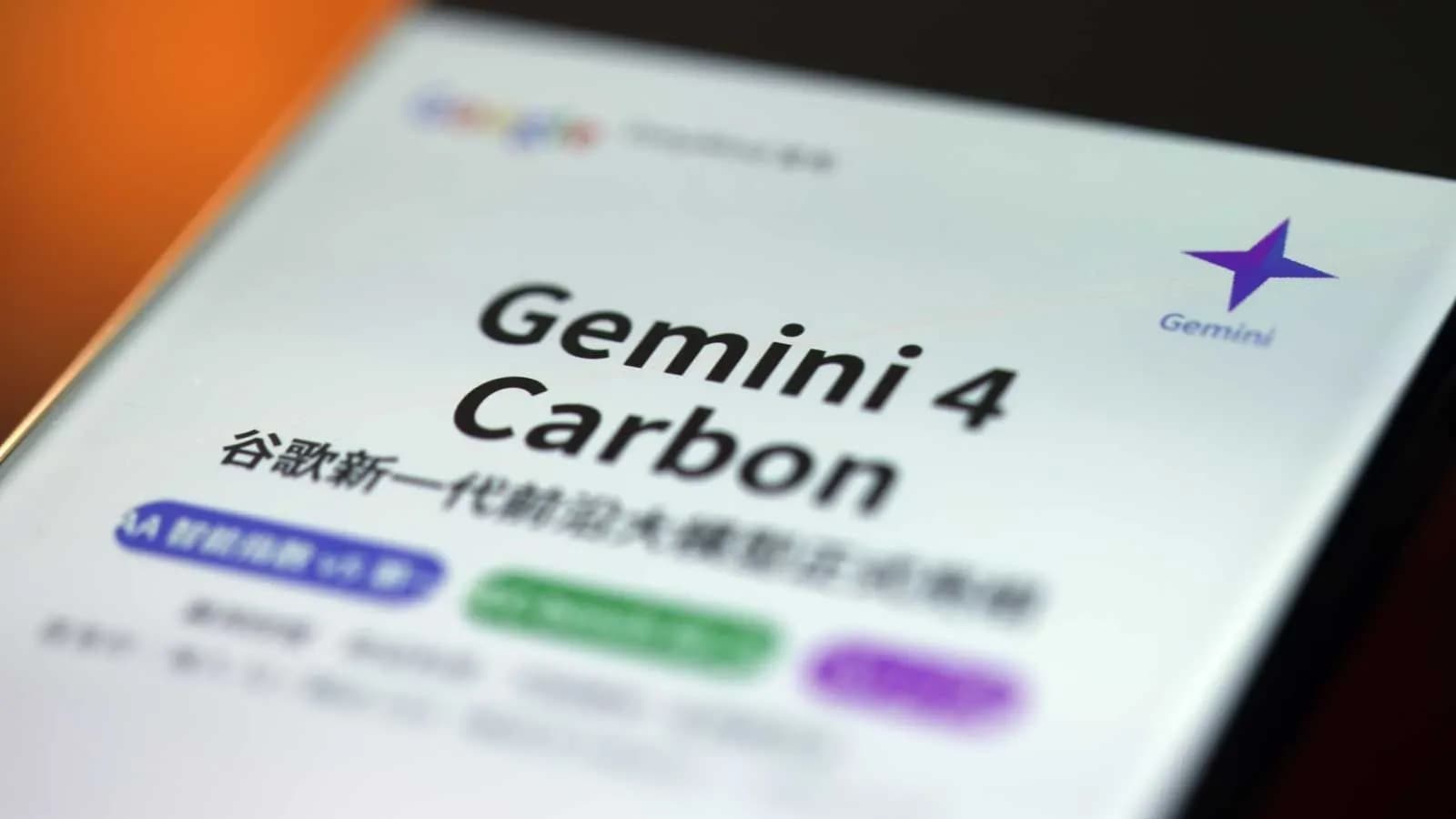
Google announced its newest AI model, Gemini 4 Carbon, last week. Scoring 59 on the latest Intelligence Index V5 suite from the evaluation platform Artificial Analysis, the model took the top spot on the list, finishing just one point ahead of Claude Opus 5.5.
Carbon posts the best score on four of the nine evaluations, and it does so at a lower cost per task than other leading models such as Claude Opus 5.5. It also leads the new AA-Omniscience v1.1 test, which measures how accurately a model recalls information and how prone it is to hallucination.
How it stacks up against rivals
According to the results, Gemini 4 Carbon is one point ahead of Claude Opus 5.5 and two points ahead of OpenAI's GPT-6 Astra. The gap widens to nine points against Meta's Muse Wonder Full and ten against Claude Fable 5.1. With model rankings expected to shift quickly and often throughout 2026, Carbon's arrival can be read as a recovery for Google after spending much of the year behind, hampered by uneven releases.
It does not lead everywhere. In programming, Claude Opus 5.5 paired with Claude Code appears to be stronger, while Grok 4.7, Muse Wonder and Kimi K3.1 Pro sit ahead of Carbon on knowledge-work tests.
The cost picture
The Pareto frontier, which plots intelligence against cost, has become an increasingly important yardstick for model developers. Carbon's cost per Intelligence Index task is $7.76. That is roughly 23 percent below Claude Opus 5.5's $10.04, but about 1.2 times GPT-6 Astra's $6.25. Claude Fable 5.1 costs $12.99 per task.
The model uses 123,000 output tokens per task, around 29 percent fewer than the 173,000 used by Claude Opus 5.5. Priced at $4 and $20 at standard rates, Carbon's per-task cost is close to that of Gemini 4 Argon ($7.68), which Google introduced two weeks ago, yet it scores nine points higher on the Intelligence Index. At the lower price tiers, open-weight models from China such as GLM 5.3-Flash and DeepSeek V4 Pro stand out. DeepSeek V4.1 Flash is roughly 13 times cheaper per task but manages only 32 points on the Intelligence Index.
Hallucination score and staged access
On the AA-Omniscience Index, which runs from -100 to +100, Carbon scored 54, the highest result, and in most cases beat its rivals by wide margins. Even so, the fact that the best score is only 54 suggests that the frontier models of 2026 are still some way from consistently reliable factual recall. Google claims Carbon halves the number of unsupported claims in its answers compared with Gemini 4 Argon, released two weeks earlier. According to the company, when the model cannot complete an operation it declines to do so rather than inventing an answer or working around missing evidence. Under uncertainty it also presents sources and suggested next steps to the user more readily, which Google says cuts the model's unprompted autonomous actions by 26 percent.
Google says it has included the model in the US government's voluntary pre-release testing process. Access opens first to cyber defenders under the Fairwind program and will then expand gradually through trusted partners. The company wants to improve safeguards and make it harder for bad actors to use the model for attacks and hacking before it is offered to developers. Google also claims Carbon blocked every attempt in Gray Swan's indirect prompt-injection test to make the model do something it should not.
Comments
No comments yet. Be the first to comment.