
Amazon Unveils $250 Ring Drone Cam and $1,000 Rover Cam
Ring has announced the first two products in its autonomous home security category: the Drone Cam at $249.99 and the Rover Cam at $1,000.
 Merhabyte Newsdesk · · 3 min read
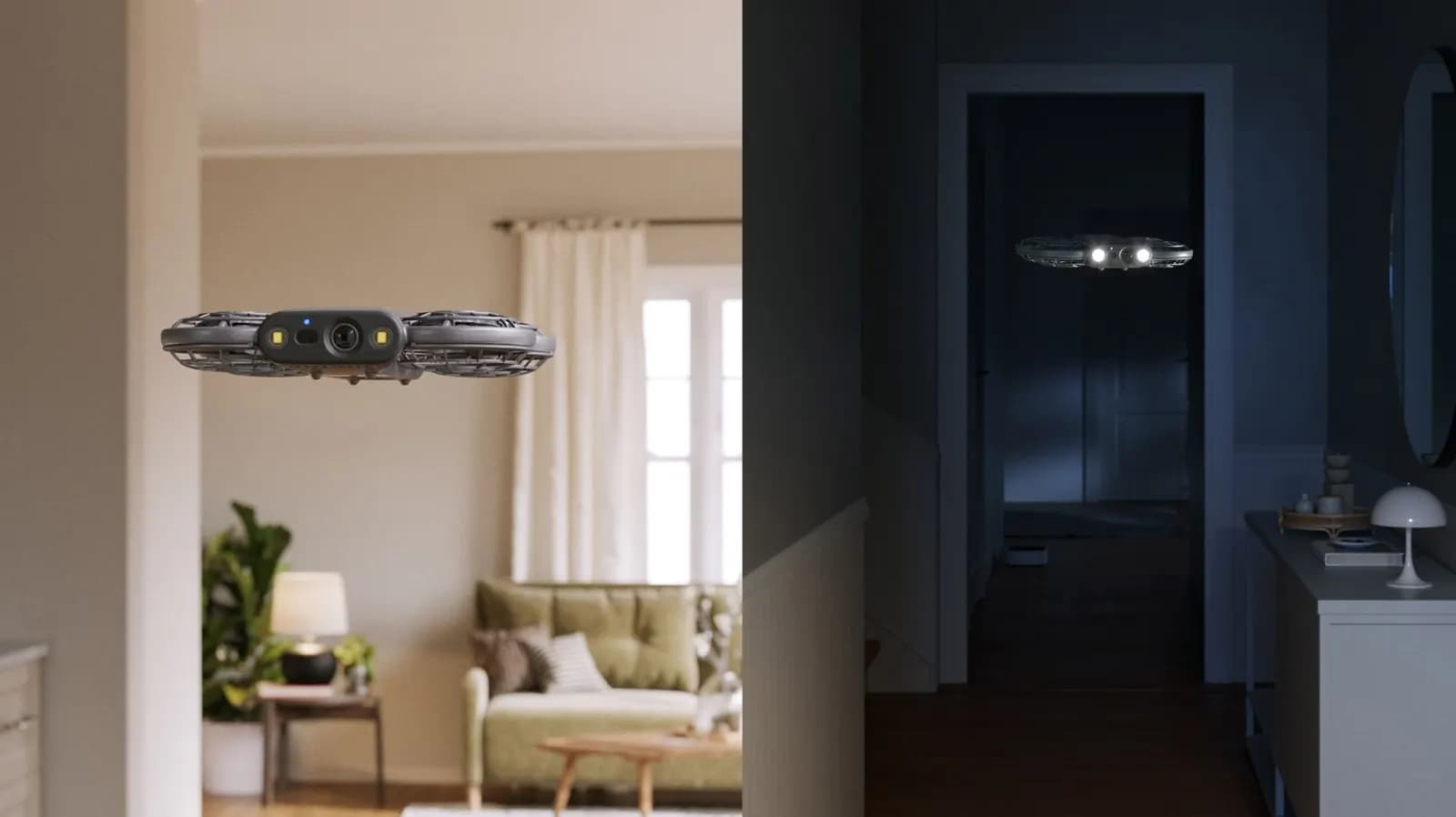
Amazon is finally preparing to put the home security drone it has hinted at for years in front of consumers. The Ring Drone Cam costs $249.99 and will begin shipping on January 27, 2027. It is one of the first two products in a new category of autonomous, mobile security devices that the company calls Ring Robotics.
The second product in the category is the Ring Rover Cam, a wheeled robot aimed mainly at small and medium-sized businesses, priced at $1,000. Ring founder Jamie Siminoff says the company has been working on the drone idea since 2016, which means the project has a history of roughly a decade.
What the Drone Cam offers
The Ring Drone Cam is a small quadcopter weighing 165 grams. The front carries a 2K camera and two LEDs, while the underside has a second, 1080p camera and a lighting LED. The lights do more than illuminate dark corners; they may also deter would-be intruders at night. According to Ring executives, moving lights in a dark house resemble a security guard checking the premises with a flashlight.
The device can patrol on preset schedules, fly to a specific spot when a motion or leak sensor in the home raises an alarm, or be launched manually at any time. Users do not need to steer it: thanks to Alexa Home Map, which Amazon announced last month, tapping a point on a 3D map of the home is enough for the drone to plot its own route.
Amazon says the battery provides roughly eight to ten minutes of flight time, depending on altitude. When the battery runs low or the Wi-Fi connection drops, the device lands or returns to its dock. Eight minutes on the dock buys one minute of flight.
A decade of technical dead ends
At a press event in New York, Siminoff said earlier versions were not good enough to release. The first drone was announced in 2021 and units were boxed up, but they never shipped because they did not work well enough. Another attempt in 2025 showed that more sensors and more processing power were needed, which meant more energy and a bigger battery.
The added weight demanded stronger flight, which led to wider propeller guards for safety, and wider guards restricted airflow and hurt flight performance. Siminoff says solving all of this in a single device would probably have pushed the price above $5,000, far from a consumer product.
What kept weight and cost down was cloud-based processing. The system that powers both the Drone Cam and the Rover Cam is called AI Pilot. Ring says it maps the space, suggests patrol points and navigates around obstacles autonomously. Because no local AI model or powerful processors are required, the device relies heavily on a Wi-Fi connection.
Rover Cam and the privacy approach
The Rover Cam resembles Astro, the robot introduced in 2021 that gradually evolved into a security robot. Ring says the product grew out of feedback from Astro customers, who said patrol security was the feature they liked most. Astro's $2,350 business version was discontinued in 2024. The new product brings back the same idea at $1,000.
It looks almost identical to Astro: a tablet screen in place of a face, a vertical antenna-like camera on top, and a light tower at the back. Designed for business scenarios such as warehouse monitoring, it can travel to a specific target, respond automatically to disturbances and patrol custom routes on a schedule. It rotates 360 degrees and its camera rises up to 4 feet on a periscope-style mechanism. It also offers a 4K camera, a built-in siren, a speaker and a microphone. The light tower projects a blue ring onto the ceiling to show the robot's location and flashes red when the siren sounds.
Amazon stresses that privacy is the default in Ring Robotics. The drone powers down while docked and its camera stays off, recording only when a flight is triggered. The company says footage from both devices will be protected by TAKE (Throw Away the Key Encryption), which it describes as the strongest default encryption Ring has offered to date.
Add as a preferred source on Google
Comments
No comments yet. Be the first to comment.


